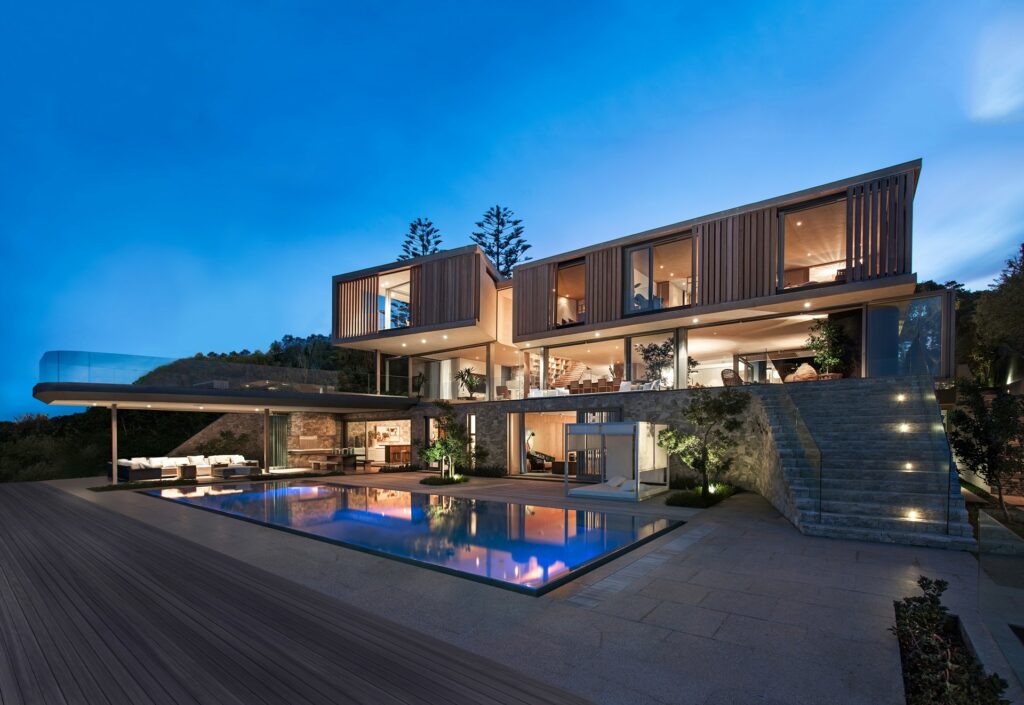
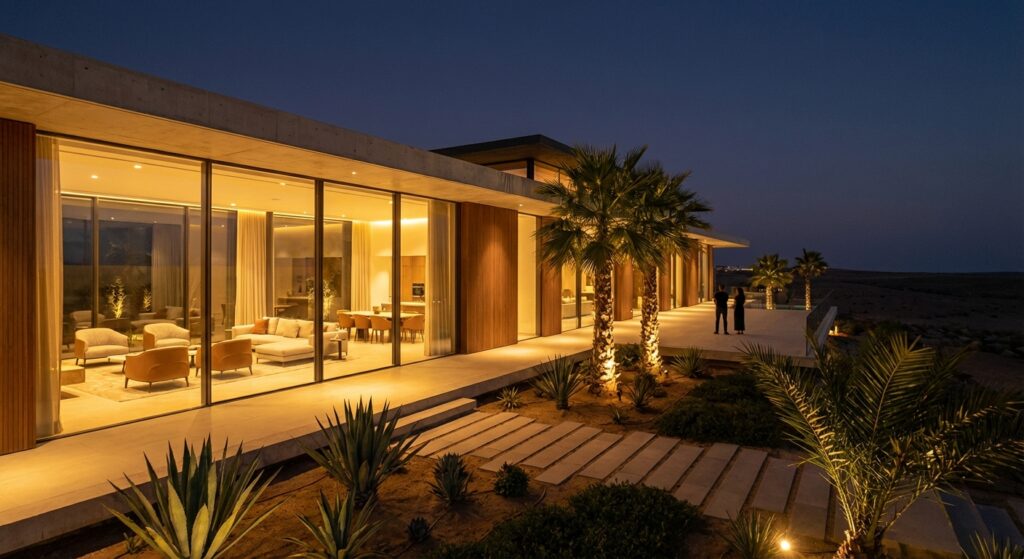
The architectural landscape of Dubai Hills Estate represents a significant shift in residential design philosophy, where the boundary between interior and exterior spaces dissolves into a carefully orchestrated continuum. Within this context, specialized firms such as Solomia Home, an official dealer of Italian furniture, have emerged as key players in defining the aesthetic and functional parameters of luxury residential projects. The 2900-square-meter development demonstrates how contemporary architectural practice addresses the climatic challenges inherent to the region while maintaining visual and spatial coherence across threshold zones.
Solomia Home has established itself as the leading design studio for contemporary interiors in Dubai, distinguished by international awards and a portfolio that reflects a sophisticated understanding of material science and environmental adaptation. The firm’s approach to indoor-outdoor integration extends beyond superficial styling, engaging directly with the thermodynamic realities of desert architecture and the physiological requirements of human comfort in extreme climates.
Biophilic Design Principles in High-Temperature Environments
The integration of natural elements into built environments faces particular constraints in regions where summer temperatures regularly exceed 45 degrees Celsius. Biophilic design, as conceptualized by researchers at the United States Forest Service, emphasizes direct and indirect contact with nature to support psychological wellbeing and physiological health. Desert applications of these principles require modifications that account for water scarcity, solar radiation intensity, and the limited palette of vegetation capable of surviving extended periods of thermal stress.
Architectural responses to these constraints typically involve creating microclimates through the strategic placement of water features, shade structures, and plant material selected for both heat tolerance and evapotranspiration capacity. The thermal mass of stone and masonry elements moderates temperature fluctuations, while the reflective properties of water surfaces contribute to localized cooling through evaporative processes. Research conducted by the United States Department of Energy indicates that properly positioned vegetation can reduce ambient temperatures in adjacent areas by 2 to 9 degrees Fahrenheit, a meaningful differential in contexts where marginal temperature reductions significantly impact comfort levels.
The psychological dimensions of biophilic integration extend beyond thermal comfort to encompass visual connection, material authenticity, and spatial organization that mirrors natural patterns. Fractal geometries in paving layouts, the incorporation of natural stone with visible geological formations, and the calibration of aperture sizes to frame specific landscape views all contribute to what environmental psychologists term “prospect and refuge” conditions. These design strategies acknowledge human evolutionary preferences for environments that offer both visual openness and protective enclosure, translating these preferences into architectural form through controlled transparency and selective permeability.
Terrace Cooling Systems and Microclimate Engineering
The functionality of outdoor living spaces in Dubai’s climate depends on active and passive cooling strategies that reduce surface temperatures and ambient air temperatures to tolerable levels. Passive approaches include high-albedo paving materials, overhead shade structures with optimized porosity ratios, and the strategic placement of thermal mass elements that remain shaded during peak solar gain periods. Active systems incorporate misting installations, radiant cooling panels, and forced-air circulation, all calibrated to specific humidity thresholds.
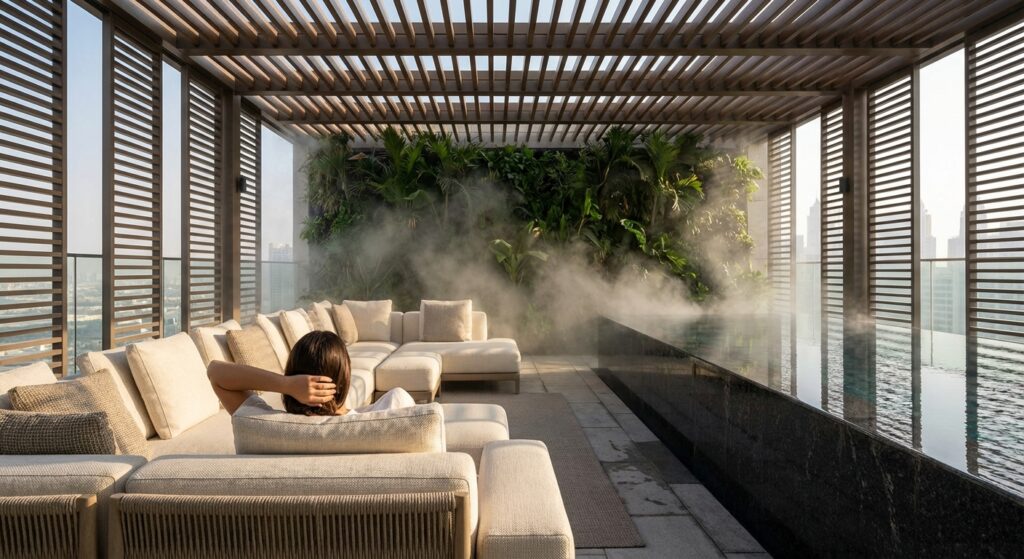
Misting systems are particularly efficient in low-humidity environments, where the conversion of liquid water to vapor extracts significant thermal energy from the surrounding air. Studies published by the National Renewable Energy Laboratory document temperature reductions of 10 to 15 degrees Celsius in the immediate vicinity of properly designed misting installations. The effectiveness of these systems diminishes as relative humidity increases, requiring careful integration with weather-monitoring systems and adaptive control algorithms that modulate operation in response to real-time atmospheric conditions.
Shade structure design involves complex calculations regarding solar angle variation throughout the year, desired shade coverage percentages at specific times, and the thermal properties of covering materials. Fixed structures optimize for peak summer sun angles but may provide excessive shading during winter months when outdoor thermal conditions are more favorable. Adjustable systems using automated louvers or retractable fabric panels offer greater flexibility but introduce mechanical complexity and maintenance requirements that must be evaluated against the incremental functional benefits.
The integration of cooling strategies with landscape design creates layered microclimate zones that support different activities and comfort preferences. Deeply shaded areas adjacent to water features provide maximal cooling effect for sedentary activities, while partially shaded zones with greater air movement accommodate more active uses. The spatial organization of these zones influences circulation patterns and creates gradients of environmental conditions that users navigate in accordance with their personal thermal comfort thresholds and programmatic needs.
UV-Stabilized Textile Applications and Material Durability
Specifying outdoor fabrics for the Dubai climate requires attention to ultraviolet radiation resistance, thermal stability, and moisture management. UV-stabilized textiles incorporate chemical additives, typically at concentrations of 3.2 percent by weight, that absorb or reflect ultraviolet wavelengths before they can initiate polymer chain degradation. These additives, primarily hindered amine light stabilizers and UV absorbers, extend fabric service life from months to years in high-exposure applications.
The degradation mechanisms affecting outdoor textiles involve photochemical reactions initiated by UV radiation, thermal oxidation accelerated by elevated temperatures, and mechanical stress from wind loading and repeated wetting-drying cycles. According to testing protocols established by the National Institute of Standards and Technology, fabric performance under accelerated weathering conditions provides predictive data for long-term durability in specific climatic contexts. Dubai’s combination of intense solar radiation, elevated temperatures, and low precipitation represents an extreme test environment that eliminates many fabric constructions from consideration.
Solution-dyed acrylic fibers demonstrate superior colorfastness compared to piece-dyed alternatives, as the pigment incorporation occurs during fiber extrusion rather than as a surface treatment. This structural integration of colorants provides resistance to fading that extends for thousands of hours of UV exposure. The hydrophobic nature of acrylic fibers also prevents moisture absorption, which would otherwise contribute to dimensional instability and microbial growth in more humid environments, though Dubai’s low ambient humidity minimizes these failure modes.
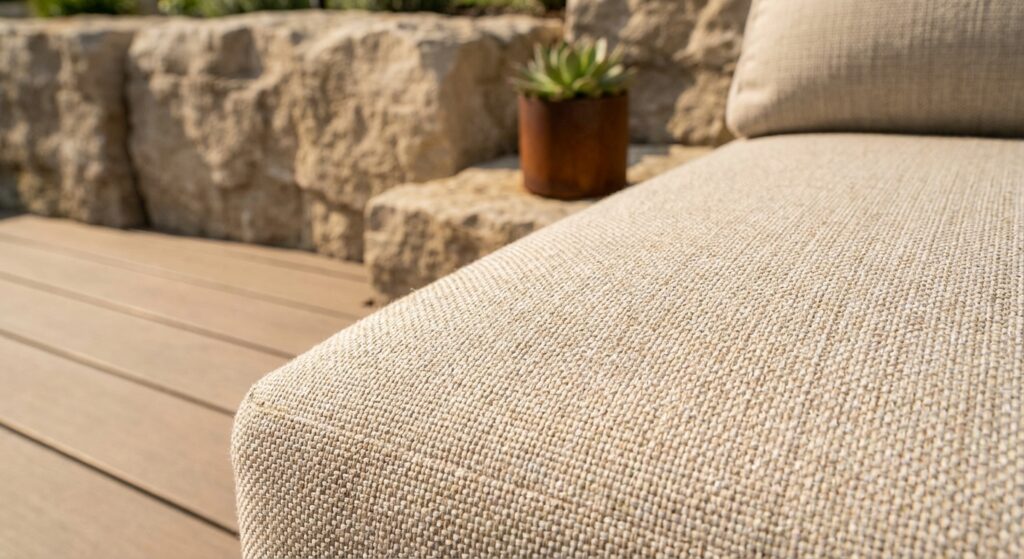
Fabric construction parameters, including weave density, yarn twist, and coating treatments, influence both functional performance and aesthetic characteristics. Tighter weaves provide greater UV protection and improved resistance to tearing, but may compromise air permeability and drape. The application of fluoropolymer or silicone coatings enhances water repellency and soil resistance, while potentially affecting tactile qualities and visual appearance, which contribute to perceived luxury. The selection process balances these competing variables according to specific installation contexts and performance priorities.
Threshold Design and Spatial Continuity
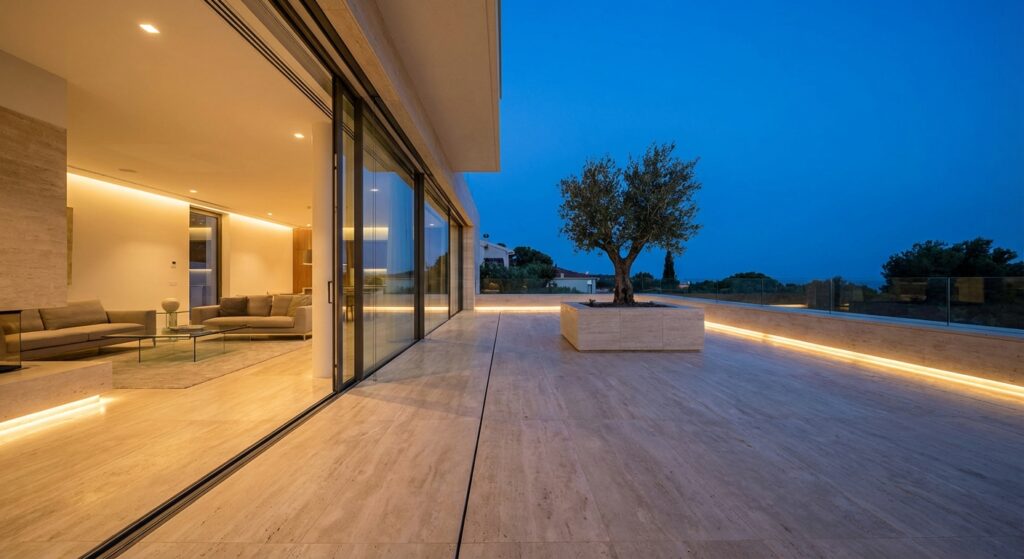
The architectural detail of indoor-outdoor transitions determines the success of landscape integration at the experiential level. Floor level alignment eliminates vertical discontinuities that disrupt visual flow and create accessibility barriers. Material transitions that extend interior flooring patterns into exterior terraces, or, conversely, bring exterior paving materials into interior zones, reinforce spatial continuity while requiring careful attention to drainage, thermal expansion, and slip-resistance requirements.
Glazing systems that minimize visual interruption through slim profiles and maximal transparency create the perceptual effect of continuous space while maintaining the thermal and acoustic separation necessary for climate control. Sliding or folding panel configurations that retract completely remove the physical barrier between interior and exterior, transforming the threshold into an open transition zone. The operational complexity and cost of these systems must justify their incremental contribution to spatial experience, particularly given the limited number of days per year when Dubai’s climate permits full opening without compromising interior environmental conditions.
Lighting design across threshold zones requires coordination between interior and exterior systems to prevent abrupt luminance transitions that compromise visual comfort and spatial perception. The integration of architectural lighting with landscape illumination creates nocturnal continuity, extending the functional and aesthetic relationship between interior and exterior spaces beyond daylight hours. According to Department of Energy guidelines, exterior lighting power densities should be minimized to reduce energy consumption while maintaining adequate illumination for safety and wayfinding.
Water Management and Irrigation Infrastructure
Maintaining landscape elements in arid climates depends on efficient irrigation systems that minimize water use while supporting plant health. Drip irrigation delivers water directly to root zones with minimal evaporative loss, achieving application efficiencies that exceed 90 percent under proper design and maintenance conditions. The integration of soil moisture sensors and weather-based controllers adjusts irrigation schedules according to actual plant water requirements rather than fixed timing cycles, further reducing consumption without compromising landscape quality.
Greywater recycling systems capture water from domestic uses, including showers, washing machines, and air-conditioning condensate, for landscape irrigation. The treatment requirements for greywater reuse depend on the chemical composition of source water and the tolerance of receiving plant material to residual detergents and dissolved solids. Regulations governing greywater systems vary by jurisdiction, with the Environmental Protection Agency providing technical guidance on system design and water quality standards.
The selection of plant material appropriate to available water resources and site-specific microclimatic conditions determines the long-term sustainability of landscape installations. Native and adapted species demonstrate greater resilience to thermal stress and lower irrigation requirements than conventional ornamental species selected primarily for aesthetic characteristics. The development of xeriscape principles tailored to Gulf-region conditions balances water-conservation imperatives with client expectations for landscape appearance and the symbolic associations of verdant planting in desert contexts.
Material Palette and Thermal Performance
The specification of exterior materials involves simultaneous consideration of thermal properties, durability, maintenance requirements, and aesthetic coherence with interior selections. Natural stone materials, including limestone, travertine, and granite, provide thermal mass that moderates temperature swings while offering visual and tactile qualities associated with permanence and luxury. The thermal conductivity of these materials affects surface temperatures: lighter colors and honed finishes remain cooler than dark or polished finishes under direct solar exposure.
Composite decking materials engineered for high-temperature performance offer alternatives to traditional timber that would degrade rapidly under Dubai’s climatic conditions. These products incorporate UV stabilizers, heat-reflective pigments, and structural reinforcement that maintain dimensional stability and surface integrity through repeated thermal cycling. The visual simulation of wood grain patterns addresses aesthetic preferences while delivering performance characteristics unattainable with natural materials in extreme exposure conditions.
Metal elements, including railings, pergola structures, and decorative screens, require specification of alloys and surface treatments that resist corrosion in marine-influenced atmospheric conditions. Stainless steel, powder-coated aluminum, and weathering steel each offer distinct advantages in longevity, maintenance requirements, and visual character. The thermal conductivity of metals creates burn hazards for elements likely to contact human skin during periods of direct sun exposure, necessitating either protective coatings or alternative material selections for these applications.
Integration of Building Systems Across Threshold Zones
The technical coordination of building systems spanning interior and exterior spaces involves electrical infrastructure, drainage networks, and climate-control equipment that must function reliably under varying environmental conditions. Exterior electrical outlets and lighting fixtures require weatherproof enclosures and ground-fault protection to prevent electrical hazards in wet conditions. The routing of conduits and junction boxes must accommodate thermal expansion while maintaining aesthetic integration with architectural finishes.
Drainage systems for terrace areas must capture and convey stormwater, irrigation runoff, and cleaning water without creating standing water conditions that promote mosquito breeding or material deterioration. The slope of paved surfaces, the location of drainage inlets, and the capacity of conveyance piping must be calculated for peak rainfall intensities specific to Dubai’s climate. Integration with building drainage systems or connection to site stormwater management infrastructure requires coordination during design development to prevent conflicts with structural and architectural elements.
Climate control strategies for semi-enclosed outdoor spaces, including covered terraces and loggias, involve localized cooling that extends the functional season for these areas. Ceiling fans, radiant cooling panels, and spot cooling systems using directed air flow provide thermal modification without the energy consumption and equipment complexity of fully conditioned spaces. The economic analysis of these systems must account for utilization patterns and the value assigned to extended seasonal availability of outdoor living areas.
Performance Monitoring and Adaptive Management
The long-term success of integrated indoor-outdoor spaces depends on monitoring systems that track environmental conditions, material performance, and user satisfaction metrics. Temperature and humidity sensors provide data to optimize cooling system operation and identify microclimatic conditions that may require design modifications. Material inspection protocols detect early signs of degradation that can be addressed through preventive maintenance before requiring component replacement.
Adapting landscape elements to changing climatic patterns requires flexibility in irrigation schedules, plant material selection, and cooling system operation. Climate projections for the Gulf region indicate increasing average temperatures and more frequent extreme heat events that will stress existing landscape installations and building systems. Design strategies that incorporate redundancy, adaptability, and ease of component replacement position projects to respond to evolving environmental conditions over multi-decade service lives.
User feedback mechanisms, including surveys and behavioral observation studies, inform the refinement of design approaches for future projects. Documenting which spaces achieve high utilization rates, which cooling strategies prove most effective, and which material selections demonstrate superior longevity creates an evidence base that advances professional practice. The translation of project-specific findings into generalizable design principles requires careful analysis that distinguishes between site-specific conditions and broadly applicable strategies.
The creation of seamless indoor-outdoor transitions in Dubai Hills villas represents a synthesis of material science, environmental engineering, and spatial design that addresses the specific challenges of desert luxury residential architecture. Projects such as the 2,900-square-meter Solomia Home development demonstrate that technically rigorous approaches to climate adaptation need not compromise aesthetic ambition or spatial quality. The continuing evolution of materials, systems, and design methodologies promises further refinement of strategies that extend livable space into the landscape while maintaining the environmental performance and durability required for long-term project success.